
Executive Summary
How can benefits brokers use wellness ROI data to convince employers to invest in an employee wellness program?
For benefits brokers, presenting employee wellness ROI is about more than demonstrating potential cost savings. It’s about helping employers see the connection between healthier employees, stronger workforce performance, and meaningful business outcomes.
The most compelling wellness ROI presentations go beyond participation rates and industry averages. They connect credible research with employer-specific challenges, measurable health improvements, and a clear strategy for evaluating results. By focusing on both financial ROI and the broader value of employee wellbeing, brokers can build trust, strengthen client relationships, and position wellness as a strategic investment rather than another benefits expense.
The goal isn’t simply to prove that wellness works. It’s to show employers what better health, better engagement, and measurable progress can mean for their organization, and why the right wellness partner makes all the difference.
Where Should A Broker Presentation Start?
When a broker sits down with an employer to talk about employee wellness, the conversation can go sideways surprisingly fast.
The presentation slide deck opens. A slide appears showing participation rates, completed challenges, health assessments, app logins, and maybe a colorful graph showing engagement. The HR leader nods. Then someone from finance asks the question everyone knew was coming:
“But what does this actually do for our business?”
That is the moment when wellness ROI data either becomes powerful or becomes another collection of numbers.
Employers are not necessarily asking brokers to prove that healthier employees are a good thing. They are trying to determine whether a particular employee wellness investment deserves limited budget, leadership attention, and employee time. And those are very different questions.
For brokers presenting wellness ROI to employers, the goal should not be to produce the biggest number possible. The goal is to build the most credible business case possible.
RELATED: What Is a Broker Wellness Partnership and How Does It Work?
How To Share A Persuasive ROI Presentation

Employee wellness is already firmly established within the benefits landscape. According to the 2025 KFF Employer Health Benefits Survey, 83% of large firms offering health benefits offered at least one program addressing smoking cessation, weight management, or lifestyle and behavioral coaching. At the same time, the average annual premium for employer-sponsored family health coverage reached $26,993 in 2025.
That combination matters. Employers are interested in workforce health, but they are also under pressure to understand what their benefits investments accomplish.
The most persuasive wellness ROI presentation therefore does five things:
- Starts with the employer’s actual business problem.
- Establishes a credible baseline.
- Connects wellness activities to measurable outcomes.
- Separates projected ROI from demonstrated results.
- Shows how results will be measured and improved over time.
For brokers, this changes the conversation from “Here is a wellness program you can buy” to “Here is a workforce problem we can measure, address and manage together.” That is a much more valuable conversation.
Why Wellness ROI Is Harder Than “Savings ÷ Cost”
Traditional ROI sounds wonderfully simple:
ROI = (Financial Benefit − Program Cost) ÷ Program Cost
The math is easy. However, determining what belongs in “financial benefit” is not.
Consider an employee who begins exercising regularly, improves sleep, lowers a health risk, and misses fewer workdays. Which outcome gets attributed to the wellness program? What happens if healthcare spending does not decline during the same year? What if the employee becomes more productive but never files a lower medical claim? And what if preventive screening detects a condition earlier, temporarily increasing healthcare utilization while conceivably yielding a much better long-term health outcome?
That is why brokers should resist reducing the entire value of employee wellness to a single impressive-looking ROI ratio. Research itself supports a more refined approach.
A large randomized clinical trial published in JAMA followed 32,974 employees and found that employees exposed to a workplace wellness program reported higher rates of regular exercise and active weight management after 18 months. However, researchers did not find statistically significant differences in healthcare spending, absenteeism, job performance, or several clinical outcomes during that timeframe.
A 2021 systematic review reached a similarly cautious conclusion: the highest-quality studies did not demonstrate positive short-term financial ROI in the first few years of workplace wellness programs.
That does NOT mean workplace wellness has little or no value. It means employers deserve better than an oversimplified promise.
Start With the Employer’s Problem, Not Your Wellness Program

Imagine two employers. Employer A is a school district struggling with absenteeism, stress, and hard-to-fill positions. Employer B is a self-funded manufacturer concerned about rising healthcare claims and cardiometabolic risk. Giving both organizations the exact same wellness ROI presentation would miss the mark.
The better question is: What business problem is this employer trying to solve?
A broker wellness ROI presentation should start by identifying priorities such as:
- Rising healthcare costs
- Absenteeism
- Presenteeism and productivity
- Employee stress or worse, employee burnout
- Chronic health risks
- Retention
- Recruitment
- Employee engagement
- Benefits utilization
- Workplace culture
This is consistent with the CDC Workplace Health Model, which recommends assessing the employee population, workplace environment, and organizational factors before developing a workplace health strategy. CDC also identifies healthcare costs, absenteeism, productivity, recruitment, retention, culture, and morale among the organizational outcomes workplace health programs may influence.
In other words, diagnose before prescribing. That principle works in healthcare, and it works remarkably well in benefits consulting, too.
Establish the Employer’s Baseline Before Showing the Opportunity
Once the problem is identified, build the ROI discussion around the employer’s current reality. A generic industry statistic can create context. The employer’s own number creates relevance.
For example, instead of opening with:
“Wellness programs can reduce absenteeism.”
Start with:
“Your organization currently averages X unscheduled absence days per employee. At your average compensation level, what is that costing the organization today?”
Now the employer is no longer evaluating an abstract wellness concept. They are evaluating an existing business expense.
Depending on the available data, useful baseline measures may include annual healthcare spending, healthcare cost trends, absenteeism, turnover, workers’ compensation, employee health risks, engagement, program utilization, and employee survey results.
The WellSteps ROI Calculator, for example, allows employers and brokers to model the probable impact on healthcare costs, absenteeism, and presenteeism using organization-specific information such as total healthcare costs, the number of benefited employees, and historical healthcare cost trends.
The key word, however, is model. An ROI projection is not the same thing as a guaranteed outcome.
Present it that way. Credibility sells better than mathematical theater.
RELATED: Wellness ROI vs VOI: The Best Employee Well-being Programs Use Both
Show the Chain Between Wellness Activities and Business Outcomes
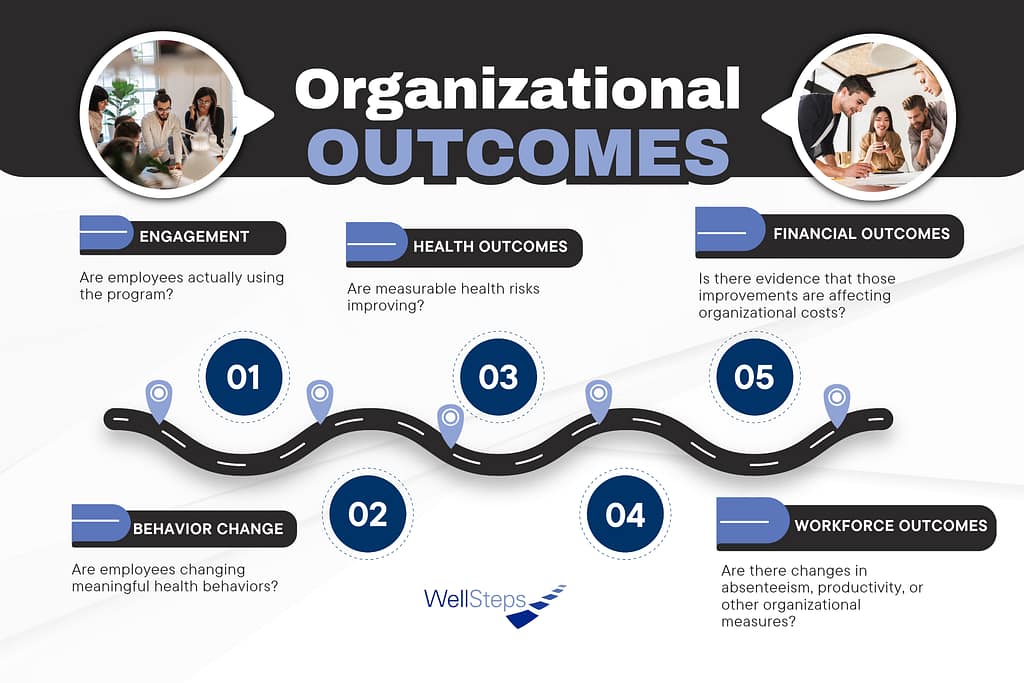
One of the biggest mistakes in a broker wellness presentation is jumping directly from: Employee completes wellness activity → Employer saves money.
With several steps missing, a more credible outcomes chain looks like this: Engagement → Behavior Change → Health Risk Change → Workforce Outcomes → Financial Impact
Each stage answers a different question.
Engagement:
Are employees actually using the program?
Behavior change:
Are employees changing meaningful health behaviors?
Health outcomes:
Are measurable health risks improving?
Workforce outcomes:
Are there changes in absenteeism, productivity, or other organizational measures?
Financial outcomes:
Is there evidence that those improvements are affecting organizational costs?
That distinction matters because participation alone is not ROI. Ten thousand challenge completions might make a beautiful dashboard. But if an employer is investing in wellness to address workforce health, the next question should be whether engagement is helping people make meaningful changes.
This is one reason WellSteps’ employee wellness research emphasizes behavior-change science, health outcomes, and measurable accountability alongside engagement.
The click is not the outcome. What happens after the click is where the business case begins.
RELATED: Why Employee Wellness Programs Simply Cannot Wait: The Real Value for Your Company
Present ROI and Value of Investment Together
Financial ROI still matters. Employers should absolutely understand the likely economic impact. But it should sit inside a wider measurement framework. Think of it as two lenses.
ROI asks: What measurable financial return did the organization receive?
Value asks: What meaningful organizational improvements resulted from the investment?
That second lens can cover outcomes such as healthier behaviors, reduced health risks, better employee experience, stronger engagement, improved productivity, lower absenteeism, or a healthier workplace culture.
This is particularly important because research on workplace wellness is heterogeneous.
A 2023 systematic review examined 138 workplace prevention interventions. Researchers reported positive ROI for 56.5% of interventions, negative for 8.7%, neutral for 9.4%, and undetermined for 25.4%. The authors also noted that randomized controlled trials produced fewer positive results than other study designs.
That is exactly why brokers should avoid presenting a universal ROI number as though every organization, workforce, and wellness strategy will produce the same result.
Instead say: “Here is what the evidence suggests. Here is what your data tells us. Here is what we propose measuring.”
That is harder to dismiss.
RELATED: How Insurance Brokers Can Win with Workplace Wellness Programs
Put the Human Being Back Into the ROI Presentation

Numbers matter because people matter. Behind an absenteeism statistic is the employee waking up exhausted and deciding whether they can make it through another shift.
Underneath a health-risk percentage is someone trying to fit movement, nutritious food, sleep, or stress management into a Tuesday already packed with work, commuting, children, and responsibilities.
It’s likely that presenteeism is driven by an employee who technically showed up but does not feel well enough to perform at their normal level.
Gallup’s 2026 research reinforces the connection between employee wellbeing and organizational performance, identifying relationships with absenteeism, healthcare utilization, employee performance, engagement, and turnover. Gallup reports that employees categorized as thriving miss substantially fewer workdays due to health problems than those who are struggling or suffering.
That human context helps leadership understand what workforce data actually represent. The goal of employee wellness is not to turn employees into healthcare cost units. It is to help real people live healthier lives and then measure how those improvements may benefit the organization, too.
Give Employers a Measurement Plan, Not Just a Prediction
Perhaps the most persuasive slide in a wellness ROI presentation is not the one predicting what could happen. It is the one explaining what happens next. Show the employer how success will be evaluated.
For example:
Baseline → Year 1 → Year 2 → Year 3
Then identify the metrics that will be monitored at each stage. Early indicators include enrollment, participation, repeat engagement, and campaign completion. Intermediate measures include physical activity, nutrition, sleep, tobacco use, stress management, or other health behaviors. Longer-term measures could include changes in health risks, absenteeism, healthcare utilization, productivity indicators, or cost trends when appropriate data are available.
This prevents an employer from expecting every financial outcome in the first six months. It also creates accountability.
The CDC specifically includes evaluation as part of its workplace health framework, recommending that organizations measure program impact, ROI, gaps and opportunities for improvement.
A strong wellness partner should therefore be able to answer more than: “What does the platform do?”
They should also be able to answer: “How will we know whether it is working?”
RELATED: Wellness Program Costs: The Numbers You Need to Know
Use Three Types of Evidence in Your Broker Wellness ROI Presentation

The strongest employer presentation combines three layers of evidence.
1. Independent evidence
Use credible third-party research from sources such as the CDC, peer-reviewed journals, and major benefits research organizations. This establishes what is reasonably supported by the broader evidence.
2. Vendor evidence
Next, show research, outcomes, benchmarks, and documented results associated with the specific wellness solution being considered.
WellSteps maintains an employee wellness research library containing studies on ROI, health behavior, health risk, and workplace outcomes.
3. Employer-specific data
Finally, connect the evidence to the employer’s workforce. This is where claims data, absenteeism, demographics, health risks, engagement data, and organizational priorities become especially valuable.
Independent evidence says: “This can work.”
Vendor evidence says: “Here is evidence behind this approach.”
Employer data asks: “What could this mean here?”
That final question is usually the one leadership cares about most.
What a Broker Should Put on the Final ROI Slide
Do not finish with 14 metrics. Close with clarity. A compelling closing slide might contain four numbers:
Current Cost
What is the problem costing the employer today?
Investment
What will the wellness strategy cost?
Target Outcome
What measurable improvement is the organization trying to achieve?
Measurement Period
When will progress and financial impact be evaluated?
Then add one sentence: “We will measure results against your baseline and adjust the strategy based on what your workforce data show.”
That sentence turns wellness from a purchase into a management strategy. And it changes the broker’s role too. You are no longer simply presenting another benefit. You are helping the employer make a better business decision.
RELATED: How Adding Wellness to Your Benefits Portfolio Sets You Apart From Every Other Broker
The Most Convincing Wellness ROI Story Is the Most Credible One

Employers have seen plenty of big promises. They do not need another slide telling them that wellness magically pays for itself. What they need is a clear connection between their workforce challenges, a thoughtful wellness strategy, and measurable outcomes that matter to their people and their bottom line.
For benefits brokers, this creates an opportunity to become more than a provider of employee benefits. It creates an opportunity to become a trusted strategic partner, one who helps employers make confident decisions, demonstrate value, and build healthier, more productive workplaces.
That is where a broker can create tremendous value.
- Start with the employer’s problem.
- Use their numbers whenever possible.
- Separate engagement from outcomes.
- Distinguish projections from measured results.
- Show both financial ROI and wider organizational value.
- Establish the measurement plan before implementation starts.
The result is not simply a better wellness presentation. It is a better business conversation. Because the strongest case for employee wellness is not an oversized promise but measurable progress.
For brokers and employers who want to explore this approach, WellSteps’ broker wellness solutions combine wellness technology, behavior-change programs, ROI tools, and dedicated wellness guidance designed to help organizations implement and evaluate their wellness strategy over time.
With 20 years of experience in employee wellness, WellSteps brings together evidence-based behavior change, individualized wellness technology, actionable reporting, and hands-on guidance to help brokers deliver more than another benefits offering. Our approach is built to help employers engage their people, encourage lasting healthy habits, and measure progress toward important organizational goals.
This is where a partnership with WellSteps makes a meaningful difference. For brokers, it means having a knowledgeable wellness partner in their corner, one that helps strengthen client relationships, support employer decision-making, and demonstrate value well beyond enrollment.
The best broker partnerships aren’t built around selling another wellness program. They’re built around helping employers and their employees achieve something better.
Discover how WellSteps’ broker wellness solutions can help you bring greater value, stronger wellness strategies, and measurable outcomes to the organizations you serve.
WellSteps. A better wellness partner. A stronger value proposition. Building healthier workplaces one at a time.
Frequently Asked Questions
Start with the employer’s specific workforce or financial challenge, establish baseline data and then show how the proposed wellness strategy connects to measurable outcomes. Separate projected savings from documented results and establish how progress will be evaluated over time.
Useful metrics can include healthcare cost trends, absenteeism, presenteeism, employee engagement, health behaviors, health risks, retention and productivity indicators. The right metrics depend on the employer’s goals, available data and expected timeframe.
No. Research findings vary considerably based on program design, population, measurement method and timeframe. Higher-quality research has found meaningful improvements in some health behaviors, though it has not consistently demonstrated short-term healthcare savings. Employers should evaluate both financial and nonfinancial outcomes using clearly defined measures.
Begin with employer-specific data such as healthcare spending, the number of employees covered by benefits, historical healthcare cost trends, and workforce productivity measures. Tools such as the WellSteps ROI Calculator can then be used to model potential impacts on healthcare spending, absenteeism, and presenteeism. Projections should be presented as estimates and subsequently compared with actual results.